Thanksgiving
Roll Count and Feather the Turkey
 Facebook
 Pinterest
 X
X LinkedIn
 Reddit
 WhatsApp
 Telegram
 Bluesky
 Email
Email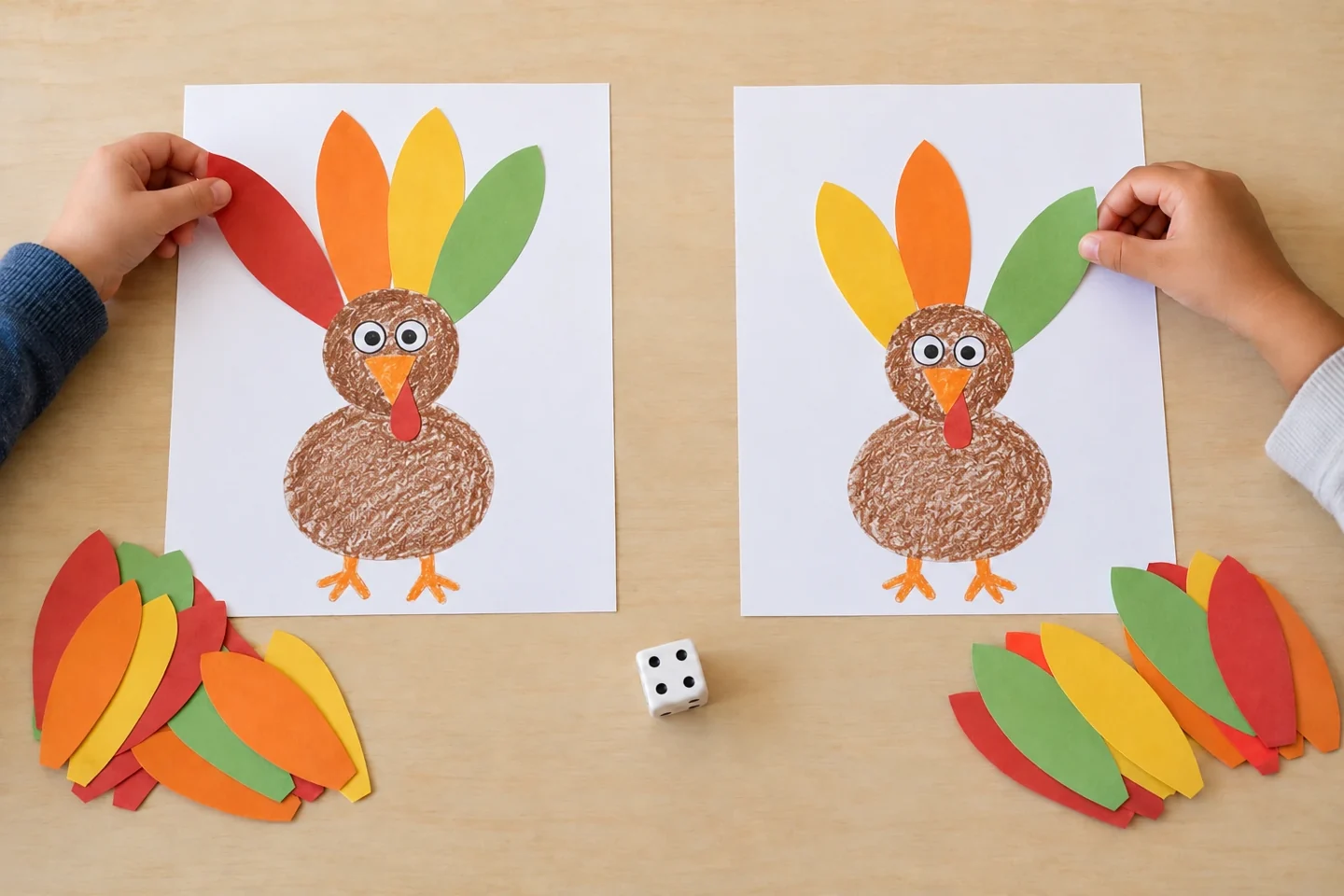
Your activity at a glance
| Suggested ages | 4–8 |
|---|---|
| Activity time | 20 minutes |
What you need
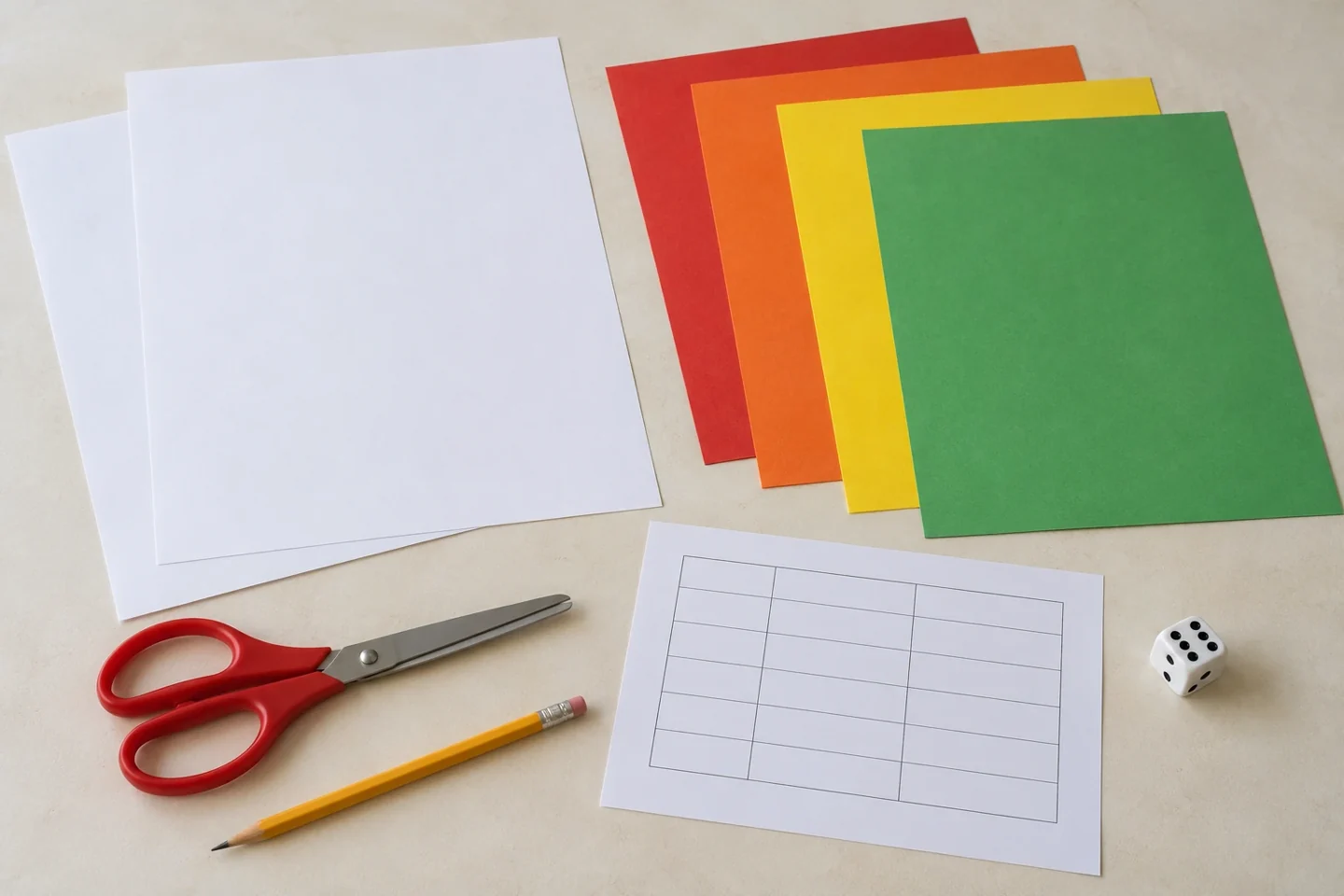
- Two letter-size paper or cardstock turkey mats
- Twenty-four large paper feathers: twelve per player
- Colored paper and adult scissors if preparing feathers yourself
- One six-sided die
- Pencil
- One spare sheet for recording rolls
- Crayons for drawing turkey bodies
A little project with plenty to discover
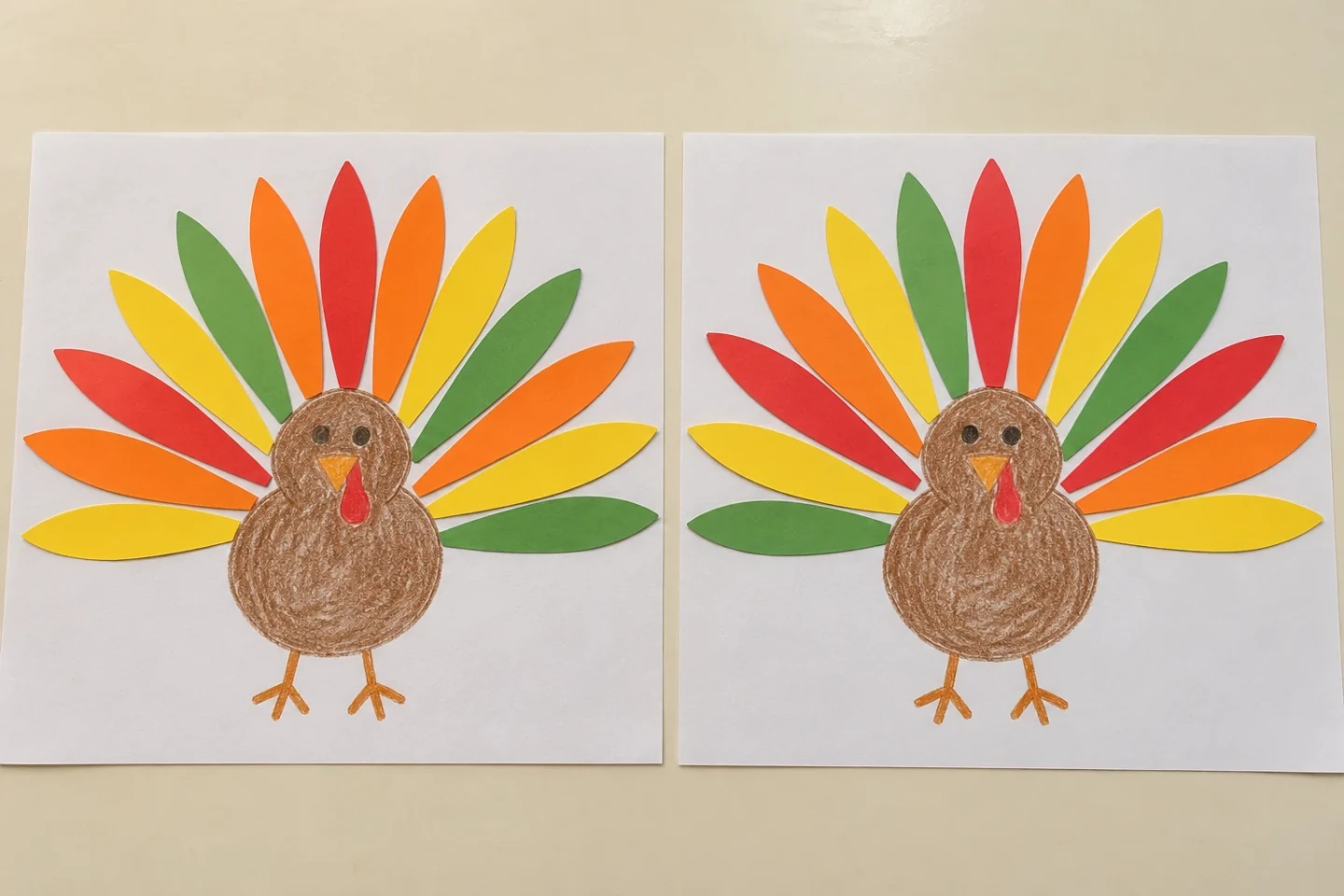
A turkey grows its feather fan one roll at a time. Children count a visible quantity, add to a collection, and compare totals without a complicated scoring system.
Draw two turkey bodies with plenty of empty space for feathers. Use twelve large feather shapes per player and choose colors that are easy to distinguish from the mat. Set the feathers in a small pile beside each turkey rather than pre-arranging them into a fan. A standard die gives quantities from one to six. Decide before play that everyone will continue until their turkey has twelve feathers; this makes the game about building and counting rather than eliminating players.
Prepare and introduce the activity
On each turn, count the die dots and move that many feathers from the supply pile onto the mat. Spread the pieces so they remain individually visible. Count the new total by touching each feather once, or begin from the previous total if the child already counts on confidently. Near twelve, explain the finishing rule with an example: if ten feathers are already placed and the die shows five, add only two. Set the unused part of the roll aside rather than overshooting the goal.
For two players, prepare 24 feathers in all and separate them into two piles of twelve. An adult can cut large rounded feathers about 3 × 9 cm from colored paper; draw the turkey bodies on two letter-size sheets. Start each body low on the page so the feather fan has room above it. On an example turn with five feathers already on the mat and a four-dot roll, move four more from the supply and count nine altogether. The missing three remain visible in the supply pile, ready for the next turn.
Make it step by step
- Draw a turkey body on each mat, leaving room above it for twelve feathers. Place each player’s feathers in a separate pile.
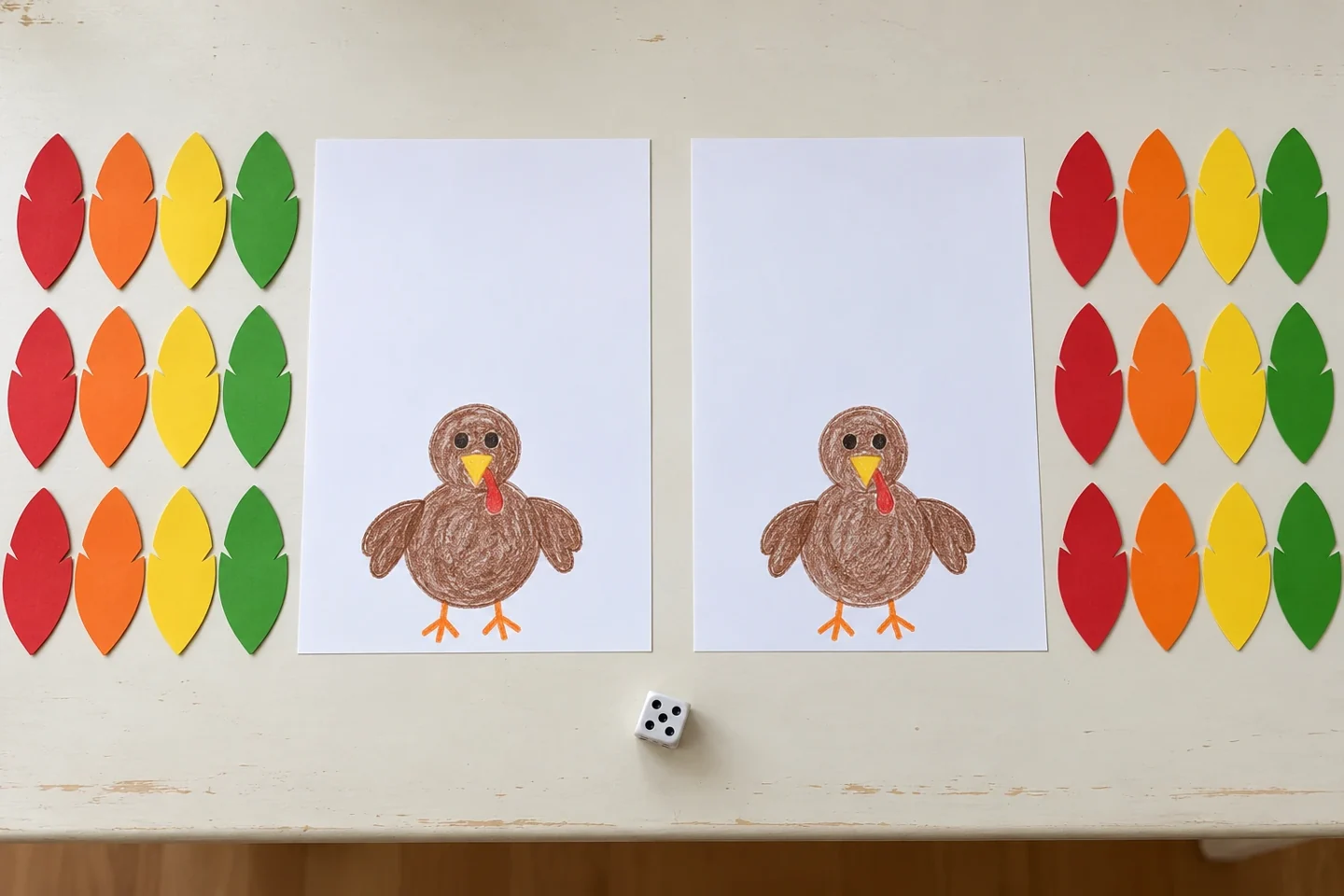
Set twelve removable feathers beside each drawn turkey before play begins. - Choose a goal of twelve feathers. On a turn, roll the die and count or recognize its dots.
- Add that many feathers to the turkey. Place them in a fan where each feather can still be counted.
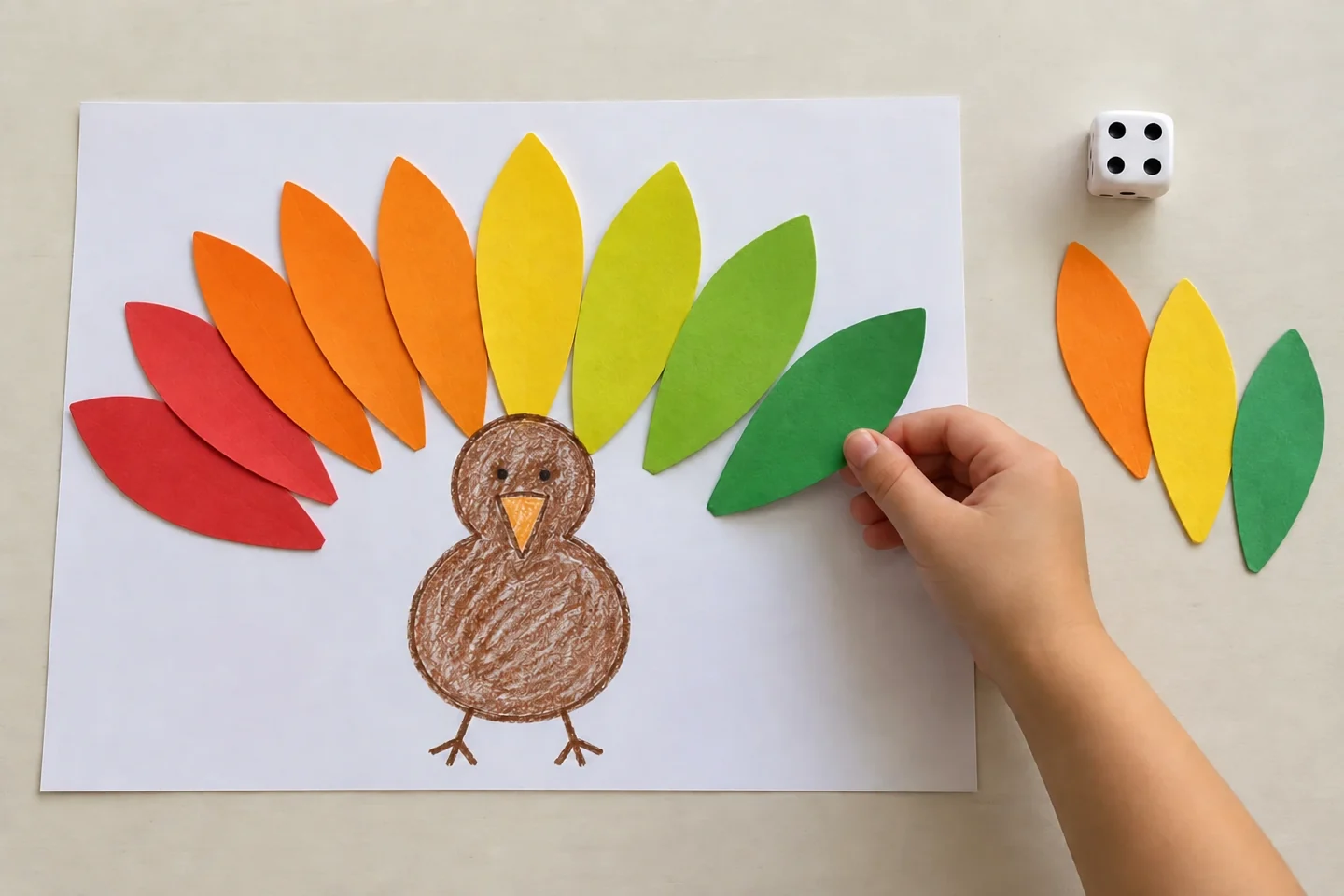
Five feathers plus a four-dot roll makes nine; three feathers remain in the supply. - Near the goal, add only the number needed to reach twelve and set aside any extra from the roll. Say how many spaces were left.
- When both turkeys are complete, count the feathers again. Try a cooperative round in which both players build one larger turkey together.
Make it work at home or in your classroom
For a younger child, use a goal of six feathers and help count the dots together. A die with numbers can be introduced later, but dots provide visible quantities for a first game. Older children can record each roll and predict how many turns might be needed. A classroom pair can build one shared turkey cooperatively, taking alternate turns and discussing the total. Children who dislike waiting can roll in parallel with separate dice, provided an adult can support the counting when needed.
Talk, notice, and learn together
How many feathers are there now? How many more will make twelve?
Ask how many feathers are on the mat and how many are still in the supply pile. The two groups together always make the starting twelve. Compare two turkeys during play without treating the larger fan as a better picture. One player may have more feathers because of the rolls, not because of greater skill. Invite children to show the difference by pairing feathers across the two mats. Any unmatched feathers make the comparison visible without requiring subtraction symbols.
Helpful fixes
Counting skips a feather: touch each piece once as you count. Waiting feels long: players can roll together with two dice or share one turkey.
Predict the next turkey total
Try a prediction round after the first game. Before rolling, ask whether a roll of one would finish the turkey, or what the smallest finishing roll would be. Keep the question tied to the actual remaining spaces. Older children can use a simple tally to compare how often each die face appeared across several games, while remembering that short runs need not be evenly distributed. For a creative ending, arrange the same twelve feathers into a new fan order and describe the color pattern.
Finish and clean up
Count the pieces back into each player’s envelope before packing the mats. This checks that the next game will have the full set and gives a final practical counting task. Store the die with the mats where younger siblings cannot access it unsupervised. Replace a damaged feather with a large paper shape of similar size; there is no need for an exact decorative match. Keep the mats unglued so they remain reusable, and use a folder to prevent the turkey bodies from creasing.